


THE ART OF BECOMING YOURSELF
-

- August 25, 2026

Phaith Montoya has spent six years in front of millions of people learning how to love the woman she once believed she had to hide. But the most radical thing she’s doing now may be learning that she doesn’t have to be fearless at all.
There is something almost deceptive about a transformation story.
We like our transformations clean.
There is a before, where someone is struggling, unhappy, broke, heartbroken, insecure, lost—or all of the above. Then comes the moment. The haircut. The breakthrough. The new body. The new career. The new life.
And then, conveniently, comes the after.
Cue the music.
Phaith Montoya has lived through the transformation. She just isn’t interested in pretending it happened that way.
Because the woman sitting on the other side of more than four million followers, international travel, major beauty and fashion campaigns, runway appearances, speaking engagements, a Survivor-style adventure in Fiji and a growing reputation as one of the internet’s most recognizable voices around body acceptance and mental health will tell you something that doesn’t fit neatly into the before-and-after mythology:
She’s still figuring it out.
“I’m very much in my healing era,” Phaith says.
It is perhaps the least flashy description imaginable for a woman whose life has become increasingly impossible to ignore.
And yet it may be the most honest.
Because Phaith’s story was never really about becoming someone new.
It was about finding the person who had been there all along.
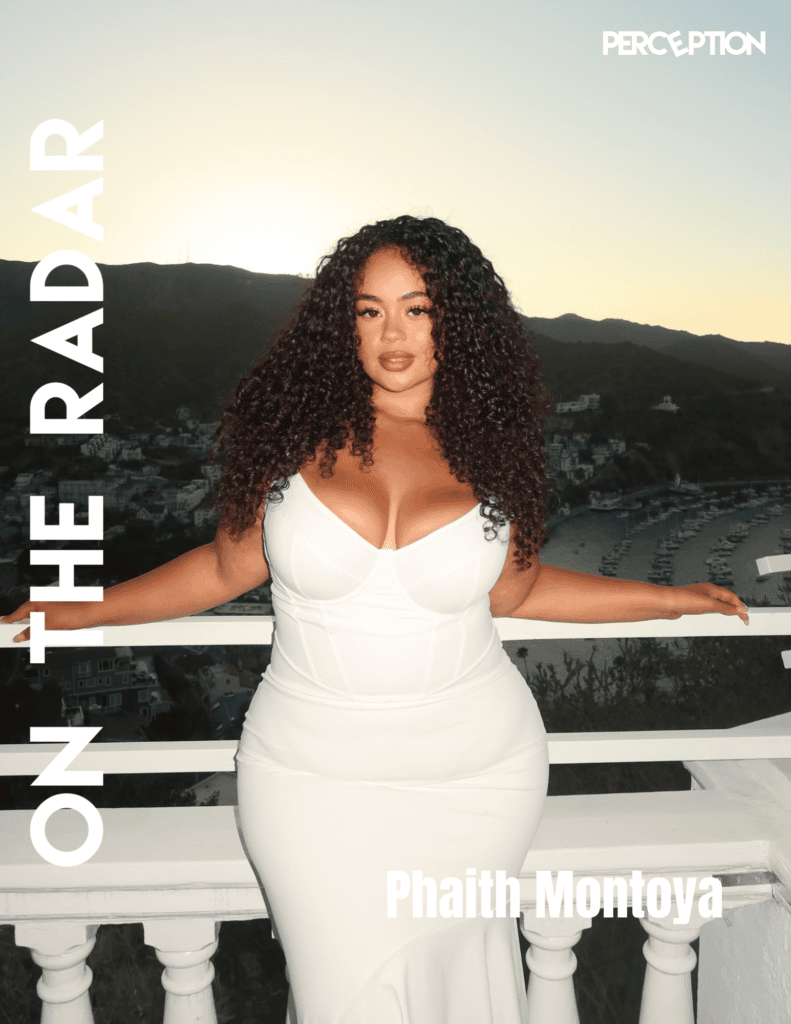
THE BIG CHOP WASN’T THE BEGINNING
In 2020, Phaith cut off all her hair.
Not a trim.
Not a dramatic new style.
All of it.
For anyone watching from the outside, it became an unforgettable image: a woman removing one of the most culturally loaded symbols of femininity and beginning again.
But Phaith remembers the moment differently.
There was liberation, yes.
There was also grief.
“I was already navigating the world as a plus-size woman, and suddenly I no longer had hair to hide behind or use as another marker of femininity,” she says.
Someone in her own family questioned her sanity. Another person called her ugly to her face.
But something strange happened after the hair came off.
The thing she believed she was sacrificing—her femininity, her beauty, her ability to feel desirable—wasn’t actually hers to lose.
“Ironically, removing something I thought I needed in order to feel beautiful helped me become the most confident version of myself.”
The internet watched her hair grow back.
What it couldn’t see was everything else growing underneath it.
Phaith was simultaneously confronting her relationship with her body, her history with an eating disorder, and the internalized fatphobia that had taught her that becoming smaller was synonymous with becoming better.
The hair was visible.
The healing wasn’t.
And that’s an important distinction in an era when social media has turned personal transformation into content.
Because the internet loves a glow-up.
Phaith has learned to distrust the idea that healing should glow at all.
THE PROBLEM WITH BEING “THE STRONG ONE”
Before she became a creator, Phaith knew how to survive.
She grew up in a low-income household. In college, she worked three jobs while relying on government assistance and scholarships. She graduated from Florida State University, became a teacher, and later pursued the possibility of medicine.
She was doing what so many people from financially precarious backgrounds are taught to do:
Keep going.
Work harder.
Figure it out.
Don’t complain.
Don’t stop.
There is a particular kind of praise reserved for people who survive difficult circumstances. We call them resilient.
We call them strong.
We call them inspiring.
What we don’t always ask is what being strong required them to sacrifice.
For Phaith, the answer is blunt.
“I truly believe it cost me my mental health.”
Her diagnosis with depression during college wasn’t an isolated event. It was an acknowledgment of years spent living in a nervous system that had never really been allowed to stand down.
“My nervous system didn’t know peace for such a long time because I was always in survival mode.”
There is a difference between surviving and feeling safe.
Phaith is learning that difference now.
And perhaps that’s why her current chapter feels so different from the one that made her famous.
She’s no longer interested in proving how much she can endure.
She’s learning how to rest.

WHAT HAPPENS WHEN THE WORLD CALLS YOU CONFIDENT?
Call Phaith confident and she may correct you.
Not because she doesn’t believe in herself.
Because confidence doesn’t quite explain what she is doing.
“I actually tell people not to call me confident because confidence isn’t always the driving force behind my actions. Resistance is.”
That word changes everything.
Resistance suggests there is still something pushing back.
A culture that says fat is bad.
An industry that tells women to fear aging.
An algorithm that rewards transformation.
A beauty standard that insists femininity has a particular shape.
A society that can make a woman feel she needs permission to wear a bikini in public.
Phaith’s answer isn’t that she has conquered those voices.
It’s that she has stopped letting them make every decision.
She still has insecurities.
She still has days when she doesn’t love what she sees in the mirror.
She simply refuses to turn those feelings into punishment.
There was a time when she wore oversized clothes to swim because she wanted her body hidden.
Eventually, she put on the bikini.
Not because she suddenly woke up one morning and thought she was flawless.
Because she wanted to swim.
She wanted to feel the sun.
She wanted to live.
“I cared more about swimming comfortably and letting my skin feel the sun.”
That may be a more radical form of body acceptance than any perfectly lit photograph could communicate.
You don’t have to love yourself every second to stop abandoning yourself.
FAT ISN’T THE OPPOSITE OF BEAUTIFUL
Phaith’s relationship with the word fat has its own history.
As a child, it was a weapon.
Kids on the school bus would chant “Fat Faith,” and she remembers running home crying and asking her mother why she had given her a name that made the insult so easy.
The word became attached to shame.
To femininity.
To worth.
To destiny.
Now?
“Fat” is simply an adjective.
“I no longer attach a negative moral value to it,” she says.
There is something quietly revolutionary about that distinction.
We are accustomed to hearing women say they are fat but beautiful.
Phaith has no interest in the “but.”
People will tell her, “You’re not fat, you’re beautiful,” as though those two things cannot coexist.
Her response is simple.
“I’m fat, and that’s okay.”
It sounds uncomplicated.
Getting there wasn’t.

THE INTERNET GETS 95 PERCENT
For someone who has built a career around visibility, Phaith has become surprisingly protective of privacy.
She jokes that she probably shares 95 percent of her life online.
The other five percent?
That’s where the sacred things live.
Her fiancé’s name, for example, remains largely unknown to her audience despite years of appearing in her content.
That isn’t an accident.
“He didn’t ask for this extremely public life,” she says. “And neither did my family.”
It is an important boundary in a culture that increasingly treats access as ownership.
Phaith chose to become public.
The people she loves didn’t.
And the bigger her platform has become, the more she has understood the difference between being visible and being available.
The distinction matters.
Especially when four million people are watching.
THE WOMAN BEHIND THE FEED
Phaith is also candid about the strange contradiction of being someone who makes a living being seen while sometimes needing to disappear.
She describes herself as neurodivergent and says she is often misunderstood because she tends to communicate exactly what she means.
That straightforwardness can be refreshing to people who know her.
Outside that context, it can become something else.
She has responded to being misunderstood by disappearing from the internet entirely for months.
But there’s a fascinating realization underneath that:
Sometimes her quietest online periods are her happiest periods offline.
“The periods when my posts are few and far between are often when I’m happiest in my actual life.”
For a creator, that sounds almost backwards.
But perhaps it shouldn’t.
We have become so accustomed to measuring wellness through productivity that we forget how deceptive productivity can be.
Phaith has experienced high-functioning depression. She knows that working harder doesn’t necessarily mean feeling better.
Sometimes the person creating the most is the person struggling the most.
Sometimes the person posting the least is actually living.
FROM TEACHER TO CREATOR
There was a time when Phaith considered influencing superficial.
Put content creation next to teaching or medicine and the comparison seemed obvious.
One changes lives.
The other sells products.
Except that’s not how her audience experienced it.
The messages started arriving.
Women and girls telling her they felt seen.
People sharing stories about their own bodies.
People talking about hair loss, cancer, alopecia, menopause, PCOS and the complicated relationships they had with their own reflection.
And Phaith realized something.
The medium had changed.
The calling hadn’t.
“When I was teaching, my students would tell me that the impact I had on them went beyond education—that I made them feel seen, understood, and cared for.”
That was the part she had loved.
Connection.
As a teacher, she could reach a classroom.
As a creator, she can reach millions.
The GRWMs, hair tutorials, fashion, beauty, travel and brand partnerships are the vehicle.
Connection is still the destination.
A DIFFERENT KIND OF MENTAL-HEALTH ADVOCATE
That connection has also brought Phaith into a much larger conversation about mental health, particularly in Black and brown communities.
As a NAMI ambassador, she has worked to challenge stigma and encourage people to seek resources and support.
Her approach isn’t to pretend mental-health struggles happen in a vacuum.
They don’t.
Phaith understands what it looks like when people don’t have access to adequate support. She understands how those gaps can affect entire families and continue across generations.
“When people don’t have access to help, those struggles can affect families for generations,” she says.
That perspective is important because mental-health advocacy can sometimes become reduced to a slogan:
It’s okay to not be okay.
Phaith’s experience suggests a more difficult question:
What happens when you aren’t okay and the resources to become okay aren’t accessible?
For her, advocacy isn’t simply about encouraging people to ask for help.
It’s about reminding people that they deserve the help in the first place.
TWENTY COUNTRIES AND COUNTING
Then there is the passport.
Before becoming a creator, Phaith had traveled to just three countries.
Now she is trying to reach thirty before turning thirty.
She’s already at twenty.
And while the challenge sounds like another impressive creator milestone, its meaning is more personal than that.
Growing up, international travel wasn’t part of the imagination.
The goal was stability.
Comfort.
Financial security.
Survival.

Travel came later, after her world expanded.
“Thirty before 30 became a fun way of challenging myself to keep exploring,” she says.
There’s something beautiful about that.
The younger Phaith was focused on making it out.
The woman she became is asking what she wants to see now that she has.
THEN SHE WENT TO FIJI
And because apparently international travel wasn’t enough, Phaith also found herself in Fiji competing in an influencer Survivor experience that stripped away many of the things that normally allow her to control how the world sees her.
No carefully curated environment.
No familiar comforts.
No easy escape.
Just exhaustion, discomfort, competition and the very real possibility of looking absolutely terrible on camera.
She watched herself back and thought she looked like a mess.
The audience apparently disagreed.
But their reaction wasn’t what stayed with her.
It was seeing herself without all the usual layers.
“When you strip away every tangible thing I normally have access to, I’m still left with my essence.”
What emerged surprised her.
She remained kind.
She remained optimistic.
She remained herself.
The experience offered her something her online career rarely can:
proof that there is a version of Phaith that exists completely outside the camera.
And that version is still enough.
LEARNING TO MOVE FOR THE SAKE OF MOVING
That philosophy has extended to her relationship with exercise.
Phaith once exercised to punish herself.
She remembers forcing herself to stay on the treadmill because she believed she needed to earn her food.
Today, she plays pickleball.
And she loves it.
There is no calorie calculation attached to the joy.
No punishment.
No bargaining.
“I no longer look at movement as punishment for what I’ve eaten,” she says. “I see it as a privilege and a reward for being alive in this body.”
It is another subtle but profound shift.
The body is no longer the problem she has to solve.
It is the place where her life happens.
SUCCESS DOESN’T END THE STORY
Phaith has achieved the thing the younger version of herself was working toward.
Financial stability.
Freedom.
Access.
Opportunity.
She can spend time with the people she loves without working multiple jobs simply to survive.
But success has brought its own complications.
Privacy.
Safety.
The strange intimacy of being recognized by strangers.
And a new kind of pressure: the higher she climbs, the farther she can fall.
“I used to love failing because failure meant I had been brave enough to try,” she says.
Now failure can happen in public.
Thousands of people can witness it.
Millions can remember it.
That changes the stakes.
But Phaith doesn’t want that fear to make her smaller.
And perhaps that’s the real battle she’s fighting now.
Not the battle to become confident.
The battle to remain willing.
Willing to try.
Willing to fail.
Willing to be misunderstood.
Willing to be imperfect.
Willing to keep living without requiring herself to become a finished product first.
WHAT PEOPLE STILL DON’T SEE
Ask Phaith what the public sees when they look at her and she has an answer.
“A fearless woman who made the decision to love herself loudly in a society that gave her every reason to do the opposite.”
That’s true.
But it isn’t the whole truth.
Underneath that fearlessness is survivor’s guilt.
Underneath the confidence is self-doubt.
Underneath the visibility is a woman who sometimes wants to disappear.
Underneath the success is someone still conscious of the people who have not yet been given the access she has earned.
And underneath the transformation is a little girl who once believed her body was a curse.
Phaith thinks about that girl differently now.
She doesn’t resent her.
She doesn’t wish she could go back and correct every mistake.
She wants to hold her.
Because that little girl was never actually born hating herself.
She was taught to.
“I think I always felt pretty,” Phaith says. “I was just ashamed of feeling pretty in a society that told me someone who looked like me wasn’t supposed to.”
There may be no more important distinction in her entire story.
She didn’t invent self-love.
She reclaimed it.
STILL BECOMING
Perhaps the most unexpected thing Phaith Montoya has learned after becoming successful is that she doesn’t owe anyone perfection.
For a long time, she believed her platform created an obligation to become some polished, flawless version of herself.
Always right.
Always informed.
Always inspirational.
Always worthy of the millions watching.
She’s letting that go.
“I’m flawed—and I’m finally becoming comfortable with letting that be visible.”
The irony is that imperfection may be precisely what made people fall in love with her in the first place.
The messy parts.
The uncomfortable parts.
The unfinished parts.
The parts that don’t fit neatly into a transformation montage.
Phaith’s life is now extraordinarily visible.
But the most important parts of her story aren’t necessarily the ones that photograph well.
They’re the quiet decisions.
The bikini.
The pickleball game.
The decision not to punish herself for eating.
The decision to protect her fiancé’s privacy.
The decision to rest.
The decision to say, “I don’t know.”
The decision to make a mistake and learn.
The decision to call herself fat without apologizing for it.
The decision to keep going while still afraid.
And perhaps most importantly, the decision to stop confusing survival with strength.
Because fearlessness, Phaith has learned, isn’t the absence of fear.
It is what you do with the fear that’s still there.
“You feel the fear, guilt, insecurity, and doubt,” she says, “and decide to move forward anyway.”
Twenty countries down.
Thirty before thirty.
Four million-plus people watching.
A career that now stretches from beauty and fashion to mental health, travel, entertainment and advocacy.
A head of hair that has grown back.
A body that no longer needs to become smaller to deserve joy.
And a woman who is still, wonderfully, unfinished.
Maybe that’s the real lesson of Phaith Montoya.
The goal was never to become the perfect version of herself.
The goal was to become herself—
and finally realize that was enough.